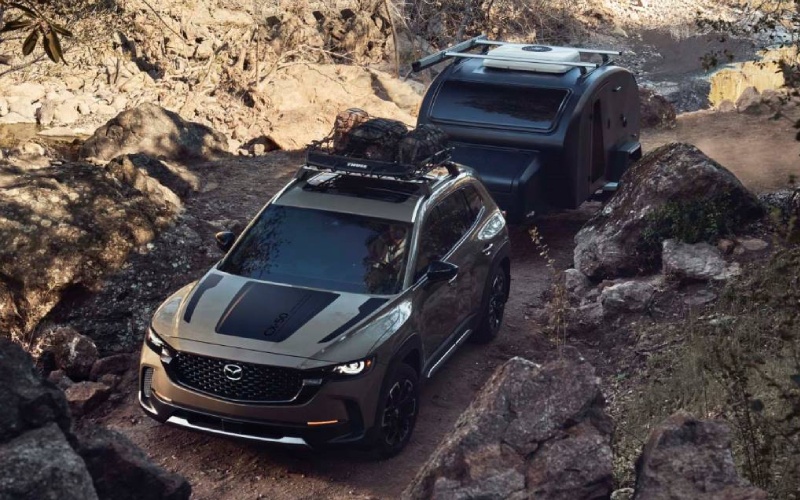
Roger Beasley Mazda Group - Is the 2026 Mazda CX-50’s AWD Better Than the 2026 Toyota RAV4’s for Georgetown, TX Driving?
Choosing between two capable compact SUVs often comes down to how their all-wheel-drive systems behave in the real world. If you drive around Georgetown, TX—where your week can swing from I-35 congestion to limestone creek crossings and hilly FM roads—the big question is simple: does the 2026 Mazda CX-50’s i-Activ AWD® deliver more usable control than the 2026 Toyota RAV4’s available AWD? The short answer is yes, because Mazda makes AWD standard on every CX-50, then tunes the chassis and software so traction and steering feel work as one.
Mazda’s i-Activ AWD® constantly reads wheel loads and driver inputs, then proactively sends torque where it will do the most good. It also integrates with G-Vectoring Control Plus, which makes subtle engine and brake adjustments as you steer—keeping the CX-50 settled when you merge, pass, or round off-camber bends on country roads. By contrast, the RAV4’s AWD is available, not standard, and while it’s competent, it does not pair with Mazda’s unique G-Vectoring Control Plus, which is a core reason the CX-50 feels so planted when surfaces change quickly.
How the AWD systems differ
The 2026 CX-50’s standard i-Activ AWD® is designed to be predictive. The system remains engaged and anticipates differences in grip before you notice them. That’s useful when a residential shortcut hides a patch of loose gravel or when a shaded curve stays slick after a brief shower. The 2026 RAV4’s available AWD helps distribute torque across axles when slippage occurs, but its tuning philosophy is more reactive than holistic, and it’s not standard on every trim.
The CX-50 also layers in Mazda Intelligent Drive Select (Mi-Drive) with Normal, Sport, and Off-Road modes on gas models, plus a Towing mode on Turbo trims when properly equipped. On the CX-50 Hybrid, you get standard Electric AWD (eAWD) with Power and Trail modes. This range of modes lets you prioritize traction, throttle response, and shift logic to match your route. Toyota offers multiple drivetrains and modes, but its approach isn’t as uniformly integrated into chassis dynamics as Mazda’s G-Vectoring Control Plus system.
Real-world traction in Central Texas
In and around Georgetown, you’ll meet situations that test traction without warning—gravel driveways on riverfront properties, dust patches from nearby construction, or uneven concrete joints along frontage roads. The CX-50’s AWD is always ready, helping the vehicle stay neutral and balanced when one side of the roadway offers less grip. You’ll feel it most when you roll into a sweeping bend on RM 2243 or head toward the parklands west of town. The SUV doesn’t fight you—it follows your hands.
RAV4’s available AWD is solid in light off-pavement situations, and we do appreciate its breadth of hybrid and plug-in hybrid offerings. But if your top priority is a consistent, confident feel whether you’re cruising on Williams Drive or taking a detour onto hard-packed dirt, the CX-50’s standard, predictive AWD and steering integration deliver the calmer, more precise experience.
Performance and towing confidence
Beyond traction, the way power arrives at the wheels shapes your daily confidence. The CX-50 offers three personalities: a naturally aspirated 2.5L for balanced driving, a responsive Hybrid with standard eAWD, and a 2.5 Turbo that supplies up to 256 hp and 320 lb-ft of torque on premium fuel (or 227 hp/310 lb-ft on regular). That turbo torque is particularly helpful when you’re merging onto I-35 or towing—up to 3,500 pounds when properly equipped—out to Lake Georgetown. Toyota’s RAV4 family spans efficient hybrids and a capable plug-in hybrid, and it can tow up to 3,500 pounds on select configurations, but it doesn’t offer a turbocharged gas engine if you like strong midrange response without a plug.
Mazda also calibrates its six-speed automatic for direct, predictable shifts—an asset on rolling terrain when you need to hold a gear through a sweep. Many drivers prefer this conventional, well-tuned automatic to a CVT’s elastic feel when the road starts to bend.
Technology that supports traction
The CX-50 backs up its mechanical tuning with smart visibility. On select trims, the 360° View Monitor with See-Through View can help you place a wheel precisely beside a curb or spot an obstacle on a narrow ranch road—useful when exploring county routes north of town. The available Adaptive Front-lighting System and auto-leveling Signature LED headlights can help you read curves earlier. Toyota’s RAV4 brings helpful tech too—Toyota Safety Sense 4.0, an available 12.9-inch multimedia screen, and available Traffic Jam Assist—but the CX-50’s camera and lighting upgrades work in tandem with its dynamics focus.
Inside, the CX-50’s clean ergonomics and available features like Bose 12-speaker premium audio and a full-color Active Driving Display complement the drive. Alexa Built-in, wireless Apple CarPlay and Android Auto, and a wireless phone charger streamline day-to-day errands so you can keep your eyes up and your mind on the road ahead.
Who benefits most from Mazda’s approach?
If you’re the kind of Georgetown driver who takes a mixed-surface lifestyle in stride—commute during the week, explore backroads on the weekend—the CX-50’s standard i-Activ AWD® and G-Vectoring Control Plus pay off every time you turn the wheel. The predictability and calm you feel through the chassis are what set it apart. The RAV4 remains a strong contender for shoppers who prioritize a particular tech feature or prefer an available system approach, but the CX-50’s foundation simply feels more cohesive across changing conditions.
When you pair that with the CX-50’s available Meridian Editions for factory all-terrain readiness—and the turbocharged option for decisive passing power—you get an SUV that adapts cleanly to the varied topography stretching from downtown to the edges of the Hill Country.
- AWD philosophy: CX-50’s standard i-Activ AWD® is predictive and integrated with steering/driveline control, while RAV4’s AWD is available and more reactive.
- Drive modes: CX-50 adds Mi-Drive modes (including Towing on Turbo and Power/Trail on Hybrid) to tailor traction and response to your route.
- Visibility aids: CX-50’s available 360° View Monitor with See-Through View and Adaptive Front-lighting System support confident maneuvering.
Frequently Asked Questions:
Do I need AWD if I mainly commute on I-35?
Yes, if you value stability in rain, construction zones, and abrupt lane changes. The CX-50’s standard i-Activ AWD® and G-Vectoring Control Plus keep the vehicle settled during quick transitions and at highway speeds.
Is the CX-50 Hybrid good for mixed city and trail use?
It is. The CX-50 Hybrid adds standard Electric AWD (eAWD) with Power and Trail modes for confident traction, and keeps the natural, cohesive feel Mazda is known for.
Which feels more confident on unpaved county roads?
Both can handle light off-pavement use, but the CX-50’s predictive AWD and dynamics tuning deliver steadier steering and more consistent traction feedback on variable surfaces.
When you’re ready to compare on your terms, schedule a test drive and feel how the steering and AWD communicate in the 2026 Mazda CX-50. From the ergonomics to the powertrain choices, it’s engineered for the driving you actually do—commutes, errands, and the spontaneous run to a trailhead north of town. Roger Beasley Mazda Group, proudly serving Georgetown, Leander, and Austin, is here to help you find the configuration that suits your routine and your weekend plans.